 Dynamic and inspiring, Amsterdam - the Netherlands' most populous city - attracts millions (yes, millions) of tourists every year. Although visitors are welcome, this popular destination in the Netherlands has decided to put the brakes on tourist fever - but not completely. Unlike other cities with too many visitors, such as Barcelona, which has put limits on the number of tourists, Amsterdam has decided to follow a different strategy: taking travellers away from the city's main points of interest.
In this way, those responsible for local tourism have managed - little by little - to dilute the patch of tourists concentrated in the heart of Amsterdam, while at the same time giving visibility to less famous but equally surprising attractions. Full of must-see places, there are localities on the outskirts of the Venice of the North that deserve to be appreciated - and photographed.
Not far from the famous canals, the coffee shops or the Red Light District, these are ideal places to have a good time with the crowds at bay. A tip: if you're planning a visit to the Dutch capital, set aside a few days of your stay to discover these treasures.
What's more, to ensure a comfortable stay you'll need the perfect accommodation option. Amsterdam boasts a diverse selection of luxurious lodging options. For a comprehensive listing and to make an informed choice, you might want to check out https://www.hotels-in-netherlands.com/en/amsterdam-hotels-18051/5-stars/ of five-star hotels.
Now, if you're exploring the city's lesser-known areas, it would also be convenient to have a nearby place to return to after a long day. For better convenience, tophotels.com offers a variety of locations throughout the city. Believe me, you won't regret it.
Laren could be the setting for a film, one whose plot revolves around a love story that would take the breath away from the most incurable romantics. Located about thirty kilometres from the centre of Amsterdam, this quiet village is frequented by many national celebrities. With luxurious shops and houses and several Instagrammable corners that are (really) worth exploring, it's also a favourite spot for retirees. Jan Rudolph de Lorm, director of the Singer Museum - a cultural relic located right in the centre of the town - describes it as the Beverly Hills of Holland. At the end of the 11th century, after the famous painter Jozef Israëls discovered the beauty of this former shepherd's land, Laren became one of the country's most famous art centres and was frequented by several artists who found inspiration for their works there, including Anton Mauve and Albert Neuhuys. Laren is also known for the Basilica of St John the Baptist (Sint-Jansbasiliek), a large Catholic monument that stands out in this small town.
VISIT
Singer Laren Museum
An inheritance from the American couple Anna and William Singer, this house of modern architecture includes a museum, theatre and sculpture garden featuring works by various artists with gardening by Piet Oudolf. It became famous after the Second World War when it exhibited works by artists from the Laren School of Painting and is one of Lauren's main attractions. Renovated in 2017, it houses an astonishing collection of art from the period between 1880 and 1950 as well as works from private art collections. According to the current director, Jan Rudolph de Lorm, it is "more than a museum".
Openinghours: the museum is open from Tuesday to Sunday from 11.00 to 17.00, and the sculpture garden, café and museum shop from 10.00 to 17.30.
Prices: 15 euros per adult (free entry with the I amsterdam City Card). The garden area is free to enter.
Oude Drift 1, 1251 BS, Laren
singerlaren.nl
Pépé Gregoire workshop
Pépé Gregoire is one of Holland's most renowned artists and this space is a must-see in Laren. Visitors can contemplate his works (bronze sculptures and also photo-sculptures, a technique he has adopted more recently) in the garden of this space and also visit the studio where the sculptor currently designs his creations. One of Pépé Gregoire's works - Hand and Foot in Embrace - is on display at the entrance to the Singer Laren Museum.
Bookings: to visit Pépé Gregoire's Atelier, send an e-mail to [email protected].
Brik 19, 1251 KS, Laren
EATING & DRINKING
Mauve Restaurant & Bar
Built in honour of the famous painter Anton Mauve, this space is in the centre of Laren. The perfect place for a light meal.
Brink 1, 1251 KR, Laren
mauve.nl
HOW TO GET THERE?
The journey to Laren takes around thirty minutes. If travellers opt for public transport to visit this town, they can take the following buses: 302 to Blaricum (departing from Amsterdam) and then the 109 or 202 to get from Blaricum to Laren.
More information: iamsterdam.com
Naarden is one of the most remarkable examples of a well-preserved fortified town. Located about thirty minutes by car from the Dutch capital (and approximately fifteen minutes from Laren), it is worthy of a fairytale. In medieval times, the town was protected by a simple moat. Over the years, there was a need to improve the defensive structure to protect the land from enemies. However, the improvements were not enough. In the 16th and 17th centuries, the French and Spanish invaders managed to occupy the territory without much difficulty. The fortress that can be visited today only began to be designed and built at the end of the 17th century. Shaped like a snowflake, Naarden's defensive formation - a fortress city integrated into the line of defence (Fortenland) of cities such as Utrecht (to the south) and Amsterdam (to the north-west) - has six bastions and is surrounded by two canals (or moats) and a pair of ramparts. At the time, it was considered one of the strongest examples of military architecture in the whole of Europe. Full of history and charm, Naarden, classified as a protected landscape, surprises at every turn.
VISIT
De Grote Kerk
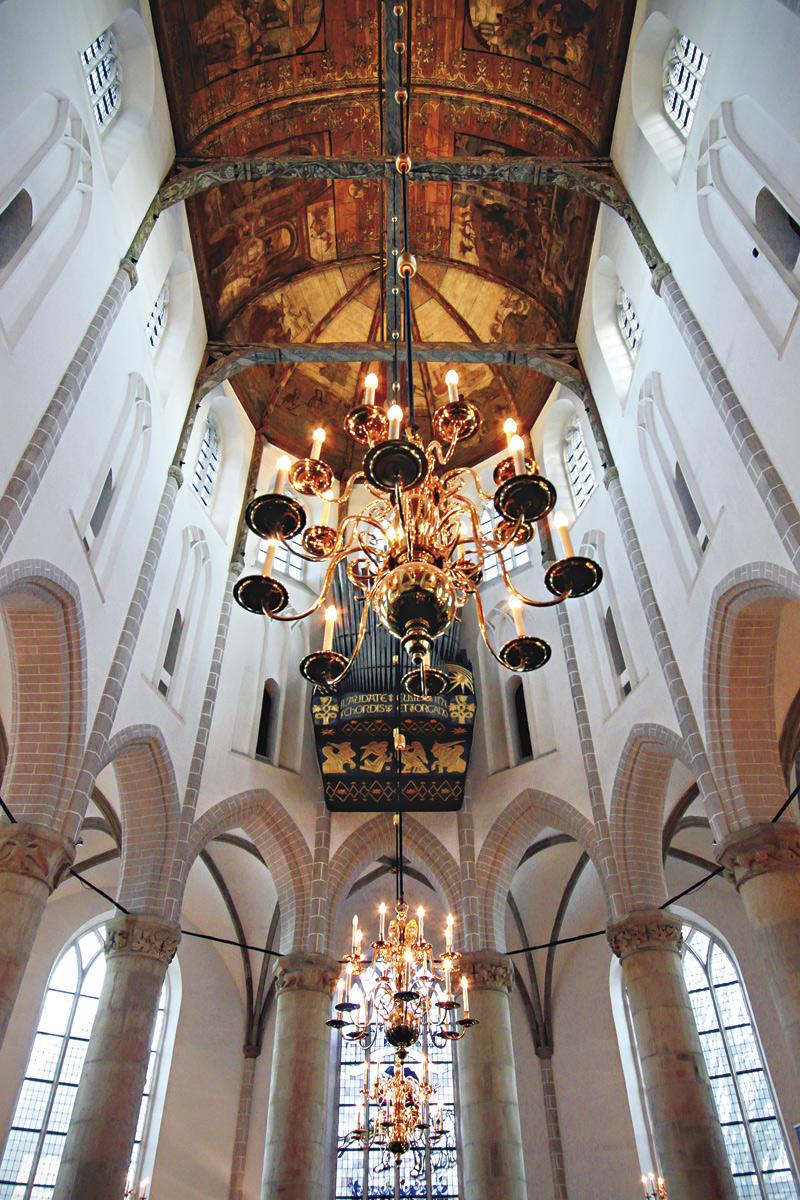
Located in the centre of Naarden, this church - also called Saint Vitus Kerk - is a must-see. From the tower of this monument, about seventy metres high, tourists can see the entire city of Naarden (and, on clear days, Utrecht and Amsterdam too) and capture panoramic views of the surprising geometry of the defensive formation. To reach the top, you have to climb almost three hundred steps - but believe me, all the physical effort will be worth it. This tower - which can be visited between May and September on Wednesdays and weekends - is the only remaining building of the original Catholic church (built between 1380 and 1440), which was later converted into a Protestant church. A curiosity? De Grote Kerk is made up of around two million bricks. Outside the church, visitors will find a statue of Jan Amos Comenius (1592-1670), a Czech Protestant pastor who is considered to be the founder of modern didactics.
Marktstraat 13, 1411 CX, Naarden
grotekerknaarden.nl
vvvnaarden.nl
Vestingmuseum (Dutch Fortress Museum)
A museum to immerse yourself in the history of Naarden and beyond. With various military artefacts, such as weapons, it's an attraction not to be missed. Tip: on Sundays there is a guided tour of the museum, which ends with a cannon shot. The Vestingmuseum is also ideal for visiting with children.
Opening hours: in July and August, open every day from 10.30am to 5pm; from September to June, closed on Mondays.
Prices: 9 euros (adults) and 5 euros (children aged 4 to 12); free entry with the I amsterdam City Card.
Westwalstraat 6, 1411 PB, Naarden
vestingmuseum.nl
EATING AND DRINKING
A-Fusion
Fusion restaurant dominated by Asian flavours. It is located in the heart of Naarden and is ideal for a meal with friends. On warmer days, opt for the outdoor area, with its "delicious" decor.
Opening hours: Tuesday to Sunday, from 17h00 to 22h00.
Marktstraat 30, 1411EA, Naarden
naarden.a-fusion.nl/naarden.html
HOW TO GET THERE?
To visit Naarden, travellers can hire a car or take a bus (line 109).
More information: iamsterdam.com
For centuries, the Dutch population fought a war with water, using dykes, dams, windmills and barrages to protect villages and farmland from the force of the sea. In the 17th century, the inhabitants were already thinking of draining the waters of the Zuiderzee inland sea, but it wasn't until the 20th century, thanks to engineering innovations, that it was possible to realise this plan and rescue the areas submerged by the water. This is how Flevoland, the Netherlands' newest province, was born (it was officially created as an administrative region at the end of the 1980s). Located approximately twenty minutes by car from the Dutch capital, this area has a lot to offer visitors. In the region's capital - Lelystad (which is housed in the world's largest polder) - tourists can contemplate the sculpture Exposure (2010). Some 26 metres high, it was designed by the artist Antony Gormley and represents a human figure looking out over the waters of the Markermeer. This sculpture is part of the Land Art circuit, an open-air exhibition in Flevoland that can be visited in just one day.
More information: landartflevoland.nl
VISIT
Batavialand Museum
It tells the story of the colossal Zuiderzee project up to the creation of Flevoland. Visitors will be able to access archives with thousands of photographs and documents that bear witness to man's struggle against the force of nature and even see one of the boats that sank there over the years. The museum is also suitable for children, as it offers various experiences about one of the main challenges the Netherlands has had to face: the fight against water.
Opening hours: Monday to Saturday from 10.00 to 17.00 and Sunday from 11.00 to 17.00.
Prices: 14 euros per adult and 7.50 euros per child (aged 4 to 12); children under 3 don't pay; free entry with the I amsterdam City Card.
Oostvaardersdijk 01-13 8242 PA, Lelystad
batavialand.nl
Oostvaardersplassen
Between Lelystad and Almere, this nature reserve has a protected area of around 56 square kilometres. Ideal for birdwatching or hiking, Oostvaardersplassen is home to several species of plants and animals, including deer, horses and foxes (some of these species were introduced to the area by man, others found the reserve and ended up inhabiting it). According to Hans-Erik Kuypers, one of the curators of Oostvaardersplassen, this reserve - whose space has been reclaimed from the sea by humans - should be classified as a national park by the end of 2018. The reserve can be visited via a safari organised by the park (in electric cars). Before visiting the reserve, you can watch De Nieuwe Wildenis (The New Wilderness), a documentary film shot in Oostvaardersplassen and seen by more than 750,000 people.
Kitsweg 1, 8218 AA, Lelystad
staatsbosbeheer.nl/natuurgebieden/oostvaardersplassen
nationaalparknieuwland.nl
HOW TO GET THERE?
To visit the Lelystad region it is best to hire a car. Visitors can also take the train from Amsterdam to the region's capital. From Lelystad station, travellers can rent a bicycle to go to Oostvaardersplassen, for example.
More information: iamsterdam.com
Dynamic, avant-garde and unpredictable. Almere breathes innovation. Just over four decades old, it is part of the province of Flevoland and on the list of Europe's fastest growing cities. It has approximately 42 kilometres of coastline and is famous for its modern architecture. Here's Almere. It was built on land that was once submerged by water (just like Oostvaardersplassen) and is about 25 minutes from Amsterdam. A city that surprises at every turn. It takes a day (or more) to get to know every corner of this territory, which was raised from the seabed in 1976 and has around two hundred thousand inhabitants. Almere is a veritable open-air museum. With buildings that defy the classical, this place is sure to take the breath away of modern architecture lovers. What's most impressive? The (elegant) fusion between contemporary design and the elements of nature. Almere's urbanisation project was designed by the famous Dutch architect Rem Koolhaas, who also designed the Casa da Música in Porto. This new city, designed to be flat and dynamic, features masterpieces by some of the world's most renowned architects, including Christian de Portzamparc, winner of the Pritzker Prize. But there are a few buildings that stand out: The Wave, by Rene van Zuuk, the Silverline - both on the water's edge - the Smargard, an orange building with a sloping façade in the city centre, and the municipal library. Because of its bold urban environment, Almere can be considered Rotterdam's sister city, another must-visit for architecture enthusiasts. The play of angles and lines that characterise Almere offers visitors an unmissable visual spectacle - and, of course, an Instagram feed full of unusual photos. A tip: to explore the city's architecture, opt for a guided tour (on foot or by Segway) so you don't miss a thing of what Almere has to offer - or hire a bike to experience it like a local.
More information: vvvalmere.nl/en | visitflevoland.nl/architecture
EATING AND DRINKING
Boathouse
This cosy waterside restaurant - whose space is reminiscent of the old water sports associations located along the banks of the great English and American rivers - features charming décor and international cuisine.
Opening hours: open every day from 11.00 to 23.00 (lunch from 11.30 to 16.00 and dinner from 17.00 to 22.00).
Noorderplassenweg 150, 1316 VV, Almere
boathouse.nl
facebook.com/boathousealmere/
STAY
Hotel Apollo Almere
Modern and futuristic, this hotel is located in the centre of Almere, close to the city's theatre and just a few steps from the shopping area. Next to the hotel is the Bierfabrik.
Koetsierbaan 2, 1315 SE, Almere
apollohotels.nl/apollo-hotel-almere-city-centre/
bierfabriek.com/almere/
Note: travellers can choose to book accommodation in Amsterdam and visit these places during the day. For those who want to stay overnight in one of these places (and not spend every day in Amsterdam), for example in Almere, we leave you with this suggestion.
HOW TO GET THERE?
Travellers who want to visit Almere have two options: hire a car or take public transport - there are six direct trains (departing every hour) from Amsterdam central station to Almere station (the journey takes approximately thirty minutes).
More information: iamsterdam.com | 9292.nl
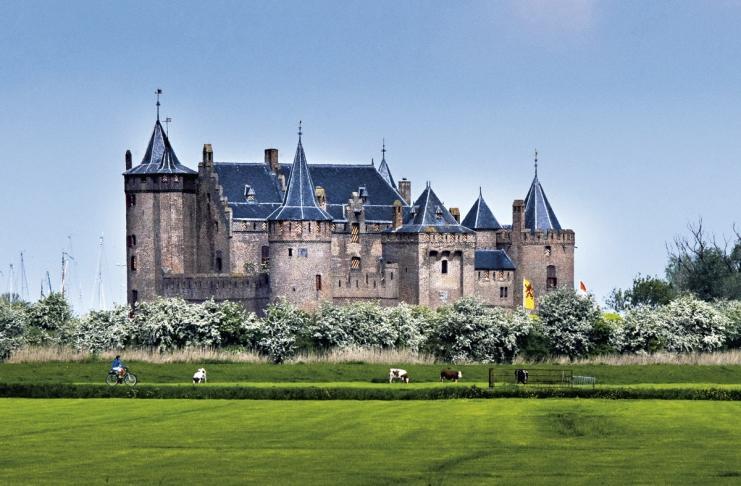
As history would have it, Muiden was a city of enchantment. Like Naarden, Muiden is also a fortified city dating back to the 10th century. Known today for its charming streets with little cafés, its historic monuments and its iconic harbour, this is a must-visit for anyone who can't do without a good history lesson - and it's only about half an hour's drive from the Dutch capital. Muiden's famous medieval castle - called Muiderslot - occupies a prominent place in the pages of tourist guides, but this charming town has so much more to offer. How about enjoying a cocktail by the water or visiting the quaint little shops with typical local products? While exploring Muiden, you might be lucky enough to come across the Green Dragon in the harbour. No, it's not a fantastic animal that lives in the depths of the sea. This is the name of the boat given by the people to Princess Beatrix, former Queen of Holland, which is usually moored in the town's harbour. Don't miss the fortified island of Pampus (built between 1887 and 1895) - the boat trip leaves from Muiden.
More information: pampus.nl/ | vvvgooivecht.nl/nl
VISIT
Muizenfort
Built between 1874 and 1877, this fort was created to secure the passage from Zeedijk to Naarden. Since 2017, it has been open to the public again and also serves as a tourist information centre.
Vestingplein 1, 1398 VE, Muiden
Sint Nicolaaskerk Church
A unique monument, also known as the Grote Kerk, located in the centre of Muiden. The church dates from the early 15th century and its tower (28 metres high) is part of the original structure, which dates back to the 12th century.
Kerkstraat 3, 1398 AJ ,Muiden
grotekerkmuiden.nl
Muiderslot Castle
This is undoubtedly Muiden's most popular tourist attraction. A UNESCO World Heritage Site, this medieval castle was built in the 13th century on the banks of the River Vlecht by the will of Count Floris V. Made of brick - since the lack of mountains in the country meant that it couldn't be built with natural stone - it is the best preserved medieval castle in the country. To carefully explore all the nooks and crannies of this monument - plus its beautiful 17th century historic garden - you need to set aside two to three hours. This is a great programme for family fun.
Opening hours: from 1 April to 31 October (Monday to Friday from 10 a.m. to 5 p.m. and Saturdays, Sundays and public holidays from 12 p.m. to 5 p.m.) and from 1 November to 31 March open only at weekends (from 12 p.m. to 5 p.m. - except on 25 and 31 December and 1 January).
Prices: free for children up to the age of 3; 9 euros per child (aged 4 to 11) and 15 euros per adult; free entry with the I amsterdam City Card.
Herengracht 1, 1398 AA, Muiden
muiderslot.nl
visitgooivecht.com
EAT & DRINK
Café Ome Ko
This famous café in the Netherlands, founded in 1810, is the perfect place to immerse yourself in the country's history while enjoying a meal or a drink. The café regularly hosts live music shows.
Opening hours: Sunday to Wednesday from 08.00 to 01.00 and Thursday and Saturday from 08.00 to 02.00.
Herengracht 71, 1398 AD, Muiden
omekomuiden.nl
HOW TO GET THERE?
To get to Muiden, travellers can take a train from Amsterdam Central Station to Weesp and then take a bus (110) to Brandweerkazerne Muiden. From there to Muiderslot Castle, for example, it's about a six-minute walk.
More information: iamsterdam.com